
E-Bike Gearing Compared: 10-Speed Freewheel vs Rohloff vs Schlumpf
Three ways to solve the same problem
A high-power e-bike asks more of its drivetrain than a pedal bike does. More torque, more weight, more speed at the top end, and often a rider who wants to keep pedalling well past the point where a normal gear range runs out.
We offer three answers. They are genuinely different in character, not just in price.
Option 1: the 10-speed freewheel
Sunrace 10-Speed Freewheel, 11–36T
A conventional derailleur drivetrain with an e-bike-rated freewheel. The 11–36T spread gives a 327% gear range, which is plenty for most riding.
In its favour: by far the cheapest option. Parts are available everywhere. Anyone can service it. Light. If something breaks on a trip, you can replace it in almost any bike shop.
Against: the exposed derailleur is vulnerable to rock strikes and crashes. Chains and cogs wear faster under e-bike torque than they do on a pedal bike. You cannot shift while stationary, which matters more than you would think when you stop unexpectedly on a climb. It needs regular cleaning and adjustment.
Choose it if: you want the most capability per dollar and do not mind maintenance. For a lot of riders this is genuinely the right answer, and we would rather say so than upsell.
Option 2: the Rohloff 14-speed hub
Rohloff Internally Geared 14 Speed Hub — $2,000
Fourteen gears sealed inside the rear hub, made in Germany. The 526% range is wider than most derailleur setups, with even steps between gears.
In its favour: almost nothing to damage, because it is all internal. You can shift while stationary — stop mid-climb, drop to first, start again. Service is an oil change roughly once a year. The chainline is straight, so chain wear drops sharply. Rohloff hubs routinely run tens of thousands of miles.
Against: the price. It adds rotating weight at the rear wheel. Shifting under full power needs a brief easing off. And it is not something a local shop will service — though it very rarely needs anything.
Choose it if: you ride a lot, ride in bad conditions, or value not thinking about your drivetrain. Available for the Scout, Titan and Trailblazer. Our Rohloff guide goes deeper.
Option 3: the Schlumpf High Speed Drive
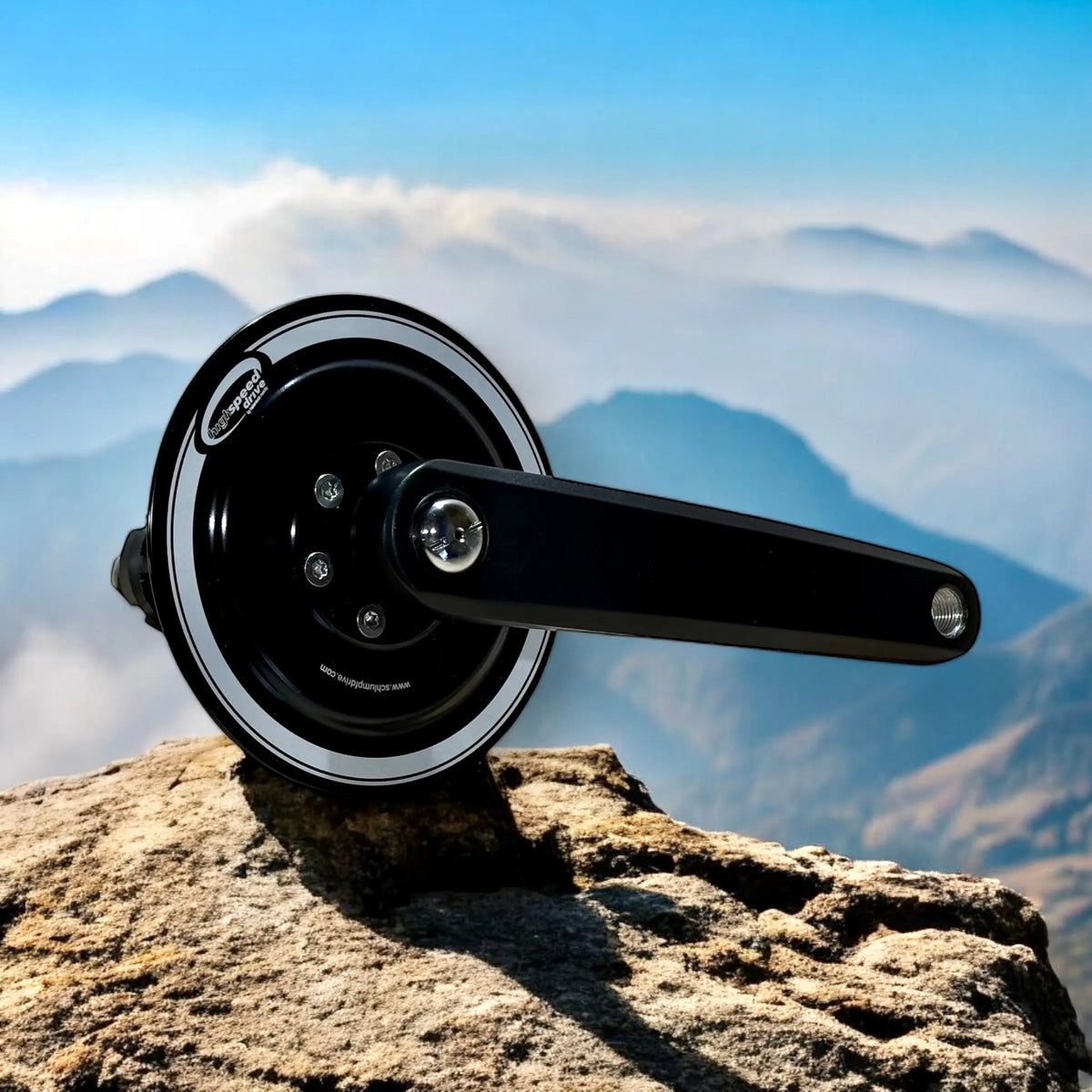
Schlumpf High Speed Drive (HSD), 30T–75T Over Drive
This one solves a different problem. It is a two-speed planetary gearbox built into the bottom bracket, giving a direct 1:1 ratio and a 2.5:1 overdrive. Tap the button with your heel and your 30T chainring effectively becomes a 75T.
The problem it solves: on a fast e-bike you spin out. Past roughly 30 mph your legs are moving pointlessly and you are just a passenger. The Schlumpf gives you a gear tall enough to keep contributing at 50 mph and beyond.
In its favour: nothing else achieves this. An 85T-equivalent chainring is not physically practical, and the Schlumpf delivers it from a 30T ring. It is sealed, and it stacks with whatever rear drivetrain you run.
Against: expensive, adds bottom-bracket weight, and only worth it if you actually ride fast enough to spin out. On a 20 mph bike it does nothing useful.
Choose it if: you ride a high-speed build and want to keep pedalling meaningfully at speed. It is standard on the Revolution X. Full detail in our Schlumpf guide.
Side by side
| Freewheel | Rohloff | Schlumpf | |
|---|---|---|---|
| Gear range | 327% | 526% | 250% (stacks with rear) |
| Shift stationary | No | Yes | Yes |
| Maintenance | Regular | Annual oil change | Minimal |
| Damage risk | Exposed | Sealed | Sealed |
| Solves spin-out | No | No | Yes |
They are not mutually exclusive
Worth saying plainly: the Schlumpf is a front-end solution and the other two are rear-end solutions. A Rohloff hub with a Schlumpf drive is a legitimate and formidable combination — enormous range, almost nothing exposed to damage, and usable gearing from a crawl to well past 50 mph. It is expensive, and for a high-mileage fast bike it is arguably the best drivetrain available.
How to decide
Ask what actually frustrates you:
- "I keep breaking derailleurs / I hate cleaning my drivetrain." → Rohloff.
- "I spin out and stop being useful above 30 mph." → Schlumpf.
- "Nothing frustrates me, I just want it to work." → the freewheel, and spend the money elsewhere.
That last answer is right more often than the industry admits. A well-maintained derailleur drivetrain is a good system, and the money saved buys a spare battery — which will improve most people's riding more than a gearbox would.

Comments