
Street-Legal Fast E-Bikes: Classes 1-3 & the 60 MPH Question

Search "street legal e-bike 60 mph" and you get a lot of contradictory answers, because two different things are getting mixed together: the class system that governs what you can ride on a public road or bike path, and the raw capability of the bike itself. An HPC Revolution can do 60 mph. Whether you're allowed to do that on a given piece of ground depends entirely on which of those two buckets you're riding in.
Here's how the class system actually works, what changes in California specifically, and how HPC classifies its high-power bikes for off-road use.
The three e-bike classes, in plain English
Most states classify e-bikes into three tiers. These classes exist to define what counts as a bicycle for bike lanes, bike paths, and road use, not to describe every e-bike on the market.
- Class 1: Pedal-assist only, no throttle. Motor assistance cuts out at 20 mph. Motor output capped at 750W.
- Class 2: Pedal-assist and/or throttle. Both cut out at 20 mph. Motor output capped at 750W.
- Class 3: Pedal-assist (throttle allowed in some states up to 20 mph), typically requires a speedometer. Motor assistance cuts out at 28 mph. Motor output capped at 750W, minimum rider age 16, helmet required.
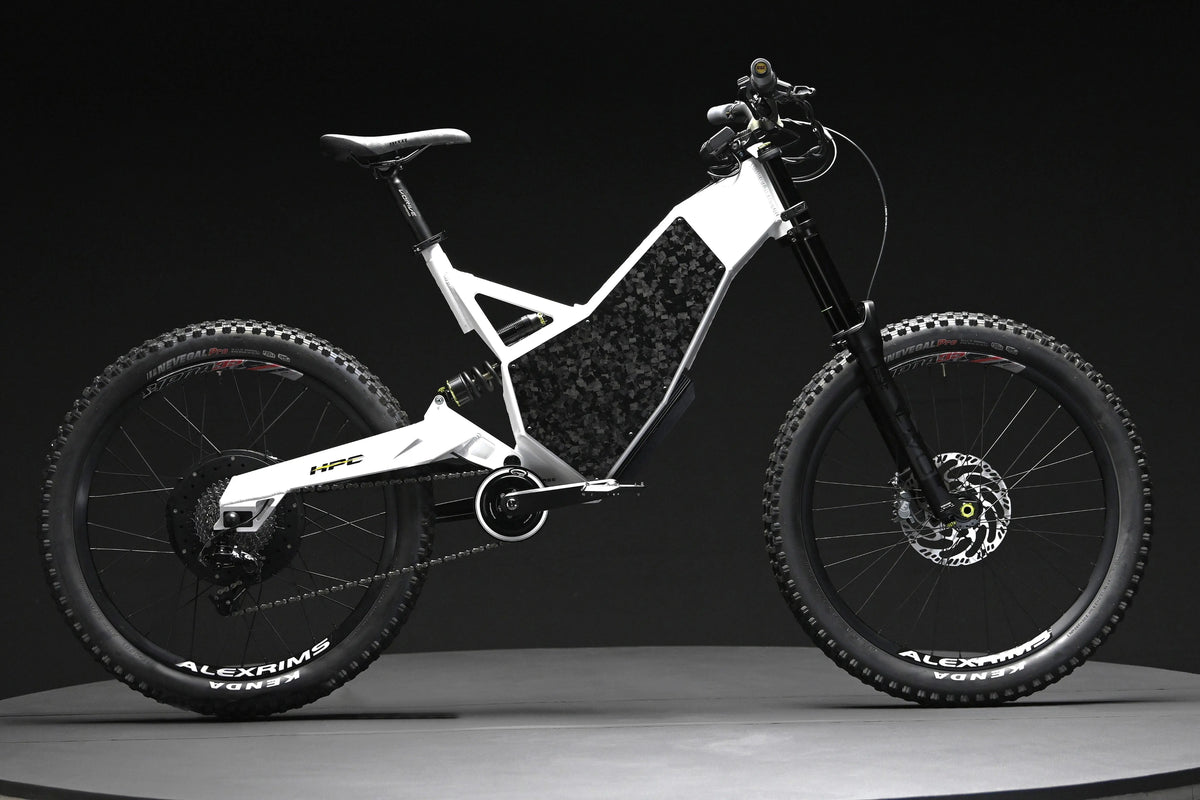
Notice the pattern: every class tops out at 750W and either 20 or 28 mph. A bike built to do 60, 80, or 100 mph, like a Revolution or Revolution W, is not a Class 1, 2, or 3 e-bike. It's operating outside the class system entirely, which is exactly why how and where you ride it matters so much.
California: the strictest interpretation
California follows the standard three-class system (AB 1096), and its classes cap at 750W and 28 mph. Under SB 1271, effective January 1, 2025, a bike capable of more than 28 mph is no longer classified as an electric bike. A two-wheeler that exceeds Class 3 limits on a public road or bike path is not treated as a bicycle under California law. It falls into motor-driven cycle or motorcycle territory, which brings registration, licensing, and insurance requirements into play. In practice, that means a full-power Revolution is not something you ride to full speed on a California public road or shared bike path, full stop. Where a bike like this can be used at full power in California is off the public right-of-way: private property you own or have permission to use, and OHV areas or closed courses where higher-powered two-wheelers are permitted.
This is why HPC classifies its high-power models, including the Revolution family, as Off-Road Only High Power Bikes. They are built for OHV areas, private property, and closed courses, not for public roads or bike paths.
Other states: more flexibility off the pavement
The class system is a public road and bike path framework, not a blanket cap on what a bike can physically do. In most states, once you're off public roads and paths, on private land, a closed course, or a permitted OHV trail, the class limits generally don't apply, because those limits were never written to govern private property or off-highway riding in the first place. That's where the real flexibility shows up: on private land or an OHV trail where higher-powered vehicles are already permitted, you can typically run an HPC build at whatever power level makes sense for how you're actually riding that day.
The practical takeaway is the same everywhere: the class rating describes how a bike behaves on a public road or path, not what the hardware is capable of, and it's the rider's responsibility to know the rules for the specific road, path, trail, or property they're on. Local laws vary and change, so always check your local regulations for your state and the specific land you're riding on before you use full power.
How HPC bikes handle this
HPC classifies its high-power models, including the Revolution and the Revolution W, as Off-Road Only High Power Bikes. They are not sold as Class 1, 2, or 3 e-bikes, and they are not street legal. They are meant to be ridden on private property, closed courses, and OHV areas that allow them, and not on public roads or bike paths. Riding one on a public road can bring motor-driven cycle or motorcycle requirements such as registration, licensing, and insurance.
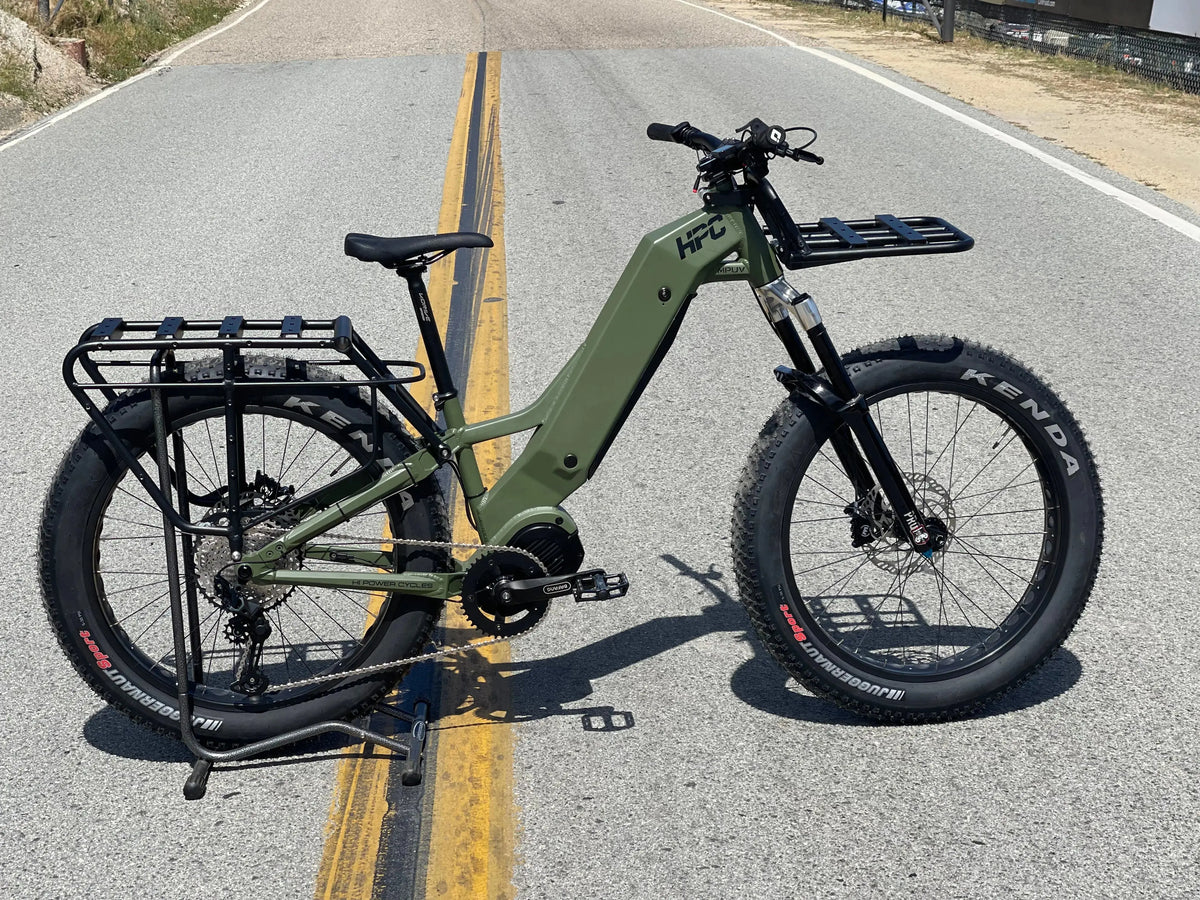
Some HPC models are also offered in lower-power configurations. For example, the Trailblazer Pro is offered as a 750W Class 1 build (20 mph) per its product page. Those are specific configurations, listed separately from the high-power builds. Check the product page for the exact configuration you are considering.
Which HPC bike fits your riding?
If you want full-power performance on private land or at an OHV area, the HPC Revolution is the easiest entry point into the Revolution family. For riders who want the top of that range, the Revolution W, HPC's collaboration with Wayne Enterprises, is listed at 80 mph and is also an Off-Road Only High Power Bike.
Whichever build you choose, the formula is the same: keep high-power bikes off public roads and paths, use them on private property, OHV trails, or closed courses where your state and local laws allow it, and check your local regulations first.
Bottom line
E-bike classes 1-3 aren't a description of how fast a bike can go, they're a description of how it's allowed to behave on public roads and paths. California caps its classes at 750W and 28 mph, and under SB 1271 a bike capable of more than 28 mph is not an e-bike, so anything beyond Class 3 falls into motor-driven cycle or motorcycle territory. Most other states follow the same basic framework, but because the class limits are a public-road and bike-path rule, private property and permitted OHV trails generally sit outside them, which is where a lot of HPC owners get to experience what their bike can really do. Know the rules where you ride, and check your local regulations before you ride.
Comments