
Revolution MX vs Revolution MX Pro: Is the 78V Upgrade Worth It?
Two bikes, one spec sheet
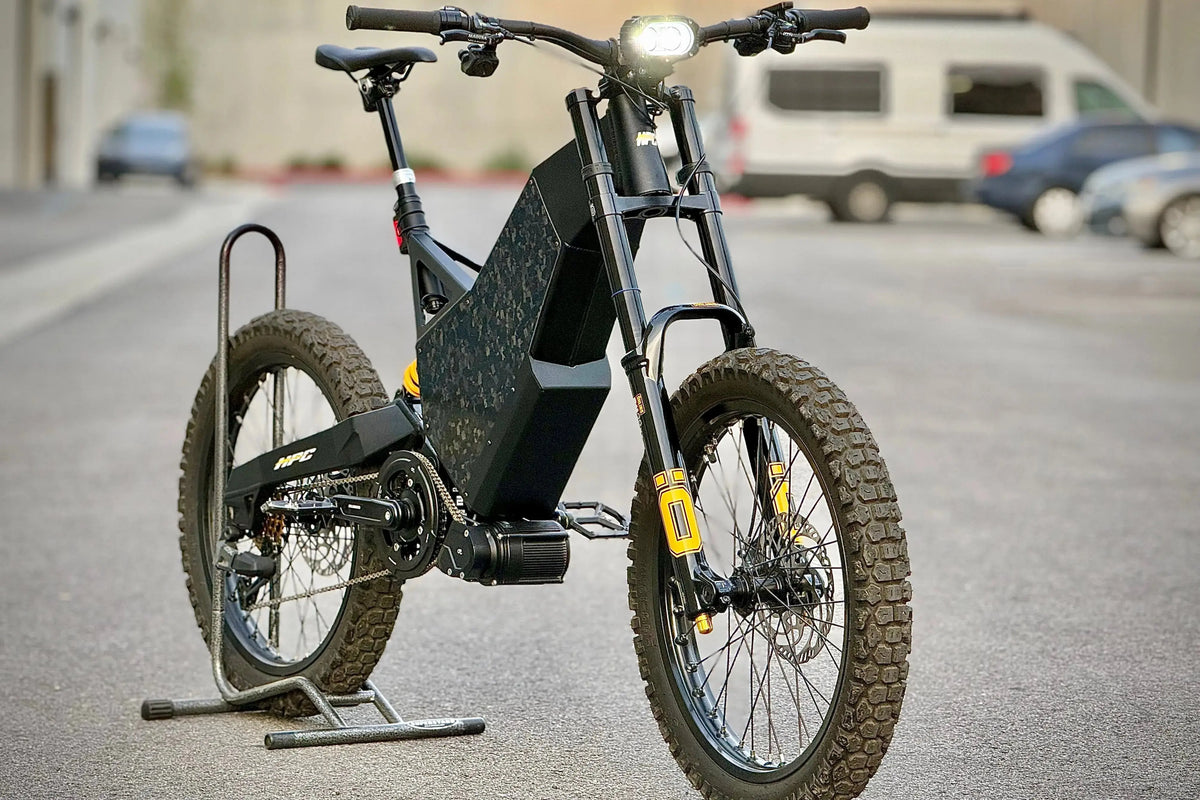
The Revolution MX and the Revolution MX Pro are the two downhill e-MTBs in our lineup, and they are closer than most model pairs.
Here is how they are published:
- Revolution MX — 72V, up to 6,000W, 100-mile range, 50 mph top speed. $10,500.
- Revolution MX Pro — 78V, up to 6,000W, 100-mile range, 50 mph top speed. $12,500.
Same peak power. Same range. Same top speed. The headline numbers do not separate these bikes, and we are not going to pretend they do. What separates them is pack voltage and $2,000.
So the honest question is not "which is faster" — it is "what does the extra voltage actually buy, and do you need it?"
What higher pack voltage changes
Power is voltage times current. If two systems make the same peak power, the higher-voltage one is doing it with less current. That has real consequences, none of which show up in a top-speed figure.
Less current for the same power
Resistive losses scale with the square of current. Drop the current needed for a given power output and heating in the pack, the cables and the controller falls disproportionately. Less waste heat is the quiet benefit that matters most on long, demanding runs.
Less voltage sag under load
Every pack sags when you pull hard on it. Sag is proportional to current draw, so a higher-voltage pack pulling less current for the same power sags less. In practice that means power delivery holds up better deep into a run, when a lower-voltage pack is starting to feel soft.
More headroom at the top of the rev range
Motor RPM scales with voltage. Both bikes are rated at 50 mph, but the 78V system reaches that speed with more margin rather than at the edge of what the pack can support. Same number on paper, more comfortable getting there.
Thermal margin, which is the real story
On a downhill bike doing repeated hard runs, the limiting factor is rarely peak power — it is whether the system holds that power on run six as well as it did on run one. Lower current means cooler components means less thermal rollback. If you are doing lift-accessed laps or long sustained efforts, this is where the Pro earns its price.
Who should buy which
The Revolution MX at $10,500
This is the right bike for most riders, and we would say that plainly. It is the lightest, most powerful 72V downhill e-MTB we make, built in the USA, and it delivers the full 6,000W and the full 50 mph. If your riding is mixed — trail days, some descending, occasional long runs — you will not find the 72V system wanting.
Put differently: the $2,000 you save buys a lot of spare batteries, tyres, brake pads and lift tickets.
The Revolution MX Pro at $12,500
The Pro makes sense when you are consistently working the bike hard enough to reach the thermal and sag limits of the 72V system. Signs that is you: repeated full-power descending runs, riding at the heavier end of the rider-plus-gear range, long sustained high-speed sections, or racing where consistency across a day matters more than a single good run.
It is also the choice if you simply want the highest-specification version of the platform and the price difference is not a deciding factor. That is a legitimate reason, and we would rather say so than invent a performance gap to justify it.
How to actually decide
Ask yourself one question: does my current bike lose power when I push it hardest?
If yes — if you recognise the feeling of a bike going soft on the fourth hard run — the 78V system is addressing the exact problem you have, and the Pro is worth it.
If no, or if you are coming from a consumer e-bike and have no frame of reference for that, start with the MX. It is a genuinely serious machine and you are unlikely to find its ceiling quickly. You can spend the difference on things that will improve your riding sooner.
What they share
Both are hand-built in the USA. Both are full-suspension downhill platforms designed around high-power delivery rather than adapted from a lighter chassis. Both are rated to 6,000W, 100 miles and 50 mph. Whichever you choose, the fundamental character of the bike is the same — the Pro is the same machine with more electrical headroom, not a different one.
If you want to see how these sit against the rest of the range, our 2026 downhill and enduro e-bike guide covers the wider lineup, and the Revolution lineup explainer walks through every model.
Still unsure? Tell us how and where you ride and we will give you a straight recommendation — including telling you to buy the cheaper one if that is the right answer.
Comments