
What Is an E-Bike? How Electric Bikes Work, Classes and What to Look For
Start here
An e-bike is a bicycle with a motor, a battery and a controller that decides how the two work together. That is the whole idea. Everything else — the classes, the wattage arguments, the price range from $600 to $30,000 — is detail layered on top of that simple arrangement.
This guide covers the detail in plain language, so that by the end you can read a spec sheet and know what it actually means for your riding.
The three parts that matter
The motor
There are two common placements, and the difference is significant.
A hub motor sits in the centre of a wheel and drives it directly. Simple, quiet, low maintenance, and it works independently of your gears. The downside is that it cannot take advantage of your drivetrain, so it is working at whatever the terrain demands.
A mid-drive motor sits at the cranks and drives the chain, which means it pulls through your gears exactly as your legs do. Downshift on a climb and the motor gets the same mechanical advantage you do. That makes mid-drives markedly better on steep, technical terrain, and it is why most serious off-road e-bikes use them.
We go deeper on this in how e-bike motors work.
The battery
Two numbers describe a pack: voltage (V) and amp-hours (Ah). Multiply them and you get watt-hours (Wh), which is the honest measure of how much energy is on board.
A 48V 15Ah pack holds 720Wh. A 52V 17.5Ah pack holds 910Wh. That second number is what determines range — not voltage alone, and certainly not the motor's wattage.
Voltage does something different: it sets the ceiling on speed and how efficiently the system delivers power. Higher voltage means less current for the same power, which means less heat and less sag under load. That is why high-performance bikes run 52V, 72V or higher rather than just adding amp-hours.
The controller
This is the part nobody shops for and everybody should. The controller decides how much current reaches the motor and how smoothly. Two bikes with identical motors and identical batteries can feel completely different depending on it.
A good controller gives smooth power from a standstill, holds output when things get hot, and can be tuned to your riding. A cheap one delivers power in a lurch and backs off the moment it warms up.
The classes, accurately
Most US states use a three-class system. These definitions matter, because they determine where you can legally ride.
- Class 1 — pedal assist only, no throttle. Motor stops assisting at 20 mph.
- Class 2 — throttle permitted. Motor stops assisting at 20 mph.
- Class 3 — pedal assist only. Motor stops assisting at 28 mph.
All three classes are capped at 750W of motor power in most states.
Class 1 and 2 bikes are generally allowed anywhere a regular bicycle is allowed, including most bike paths and many trails. Class 3 is usually permitted on roads and bike lanes but restricted from shared-use paths.
Here is the part worth being clear about: a bike that exceeds 750W or assists past 28 mph is not any of these classes. It falls outside the e-bike framework entirely and is typically treated as a motor vehicle or restricted to off-road and private land. That is not a technicality — riding a high-power machine on a shared path is illegal in most places and genuinely hazardous to people walking and cycling there.
If you are buying a fast bike, know which category it falls into before you ride it. Our guide to street-legal fast e-bikes covers the specifics.
What separates a hand-built bike from a big-box one
You can buy an e-bike for $600 or for $15,000. The difference is not marketing.
The frame. A high-power bike puts loads through the frame that a pedal bicycle never sees. Frames built for it are designed and tested for those loads. Our Revolution frame is hand-welded from 6061-T6 aluminium in the USA, with CNC-machined bottom bracket, headtube, swingarm and shock mounts rather than off-the-shelf parts — and weighs 13 lbs.
The battery. Cell quality determines how much current a pack can deliver, how it ages, and how safely it behaves when stressed. This is the single biggest hidden cost difference, and the one most worth paying for.
The brakes. An e-bike is heavier and faster than the bicycle it resembles. Brakes sized for a 25 lb pedal bike are not adequate on a 70 lb bike doing 40 mph. Four-piston hydraulic brakes with large rotors are not a luxury at these speeds.
Serviceability. Can you get a replacement battery in three years? A derailleur hanger? A controller? On a hand-built bike from a company that stocks parts, yes. On a closed-out direct-to-consumer model, often no.
Choosing the right bike for you
Work backwards from the riding, not the spec sheet.
Commuting and paths. You want a Class 1, 2 or 3 bike. Range and comfort matter far more than peak power, and staying within the class system keeps your route options open.
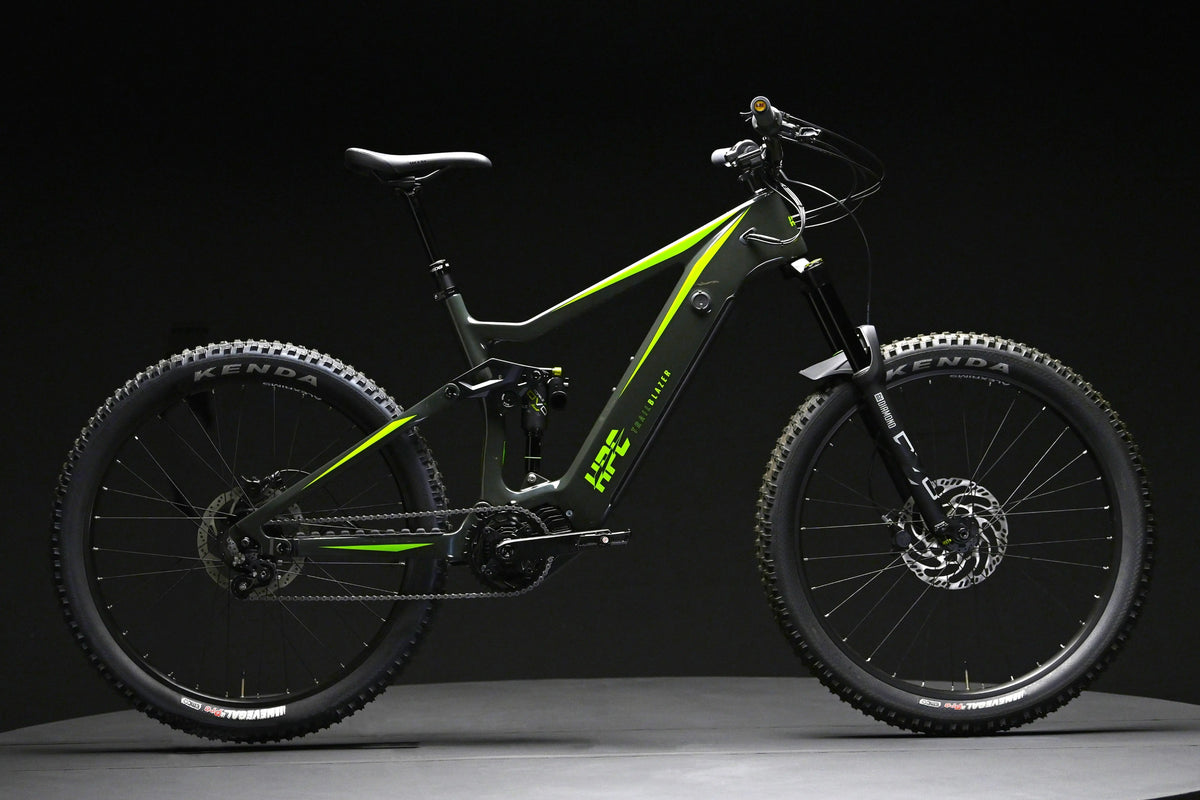
Trail and enduro riding. You want a mid-drive, full suspension, and a frame built for it. The Trailblazer ($6,800) is our full-carbon trail platform; the Trailblazer Pro ($13,000) is the top of that line.
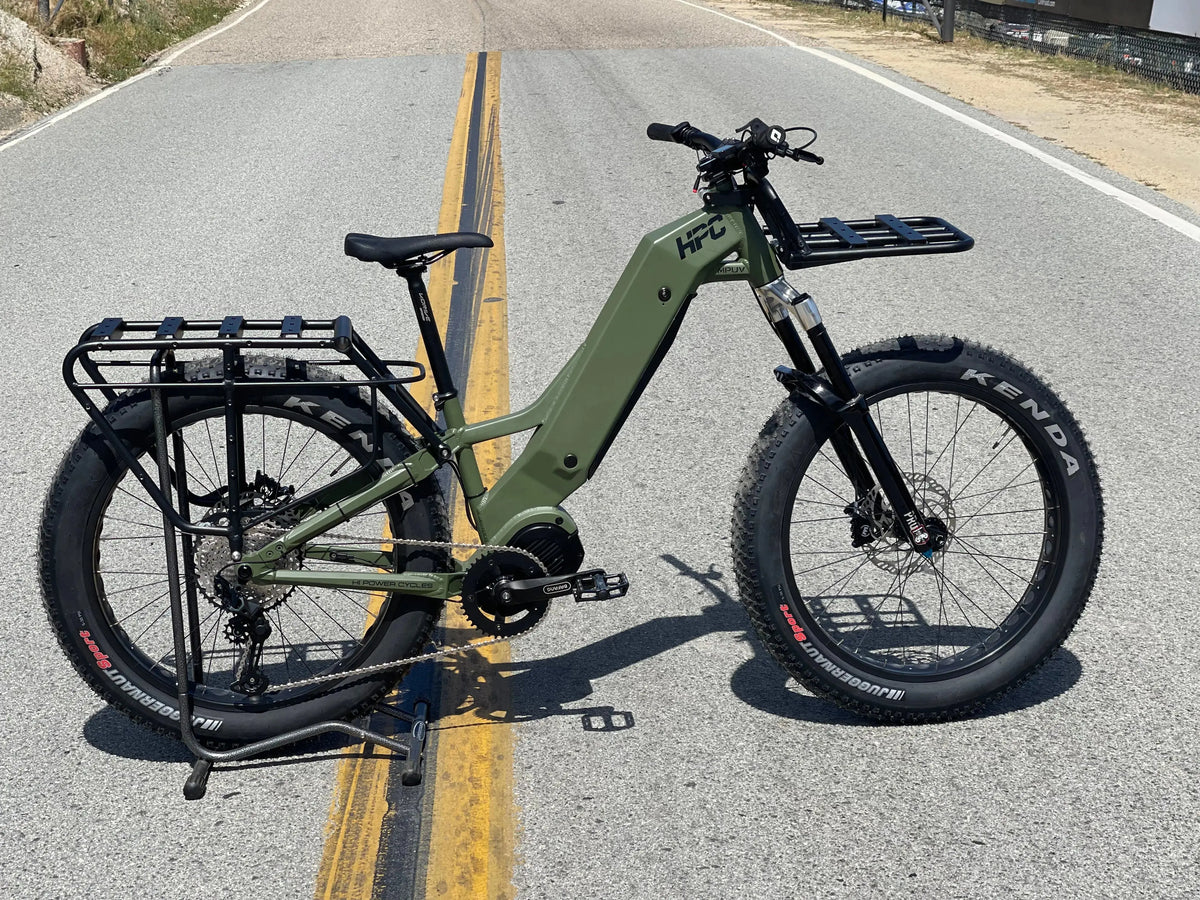
Snow, sand and backcountry. Fat tyres. The Trailblazer AT and Trailblazer AT Pro cover that, as does the Titan for hunting and hauling.
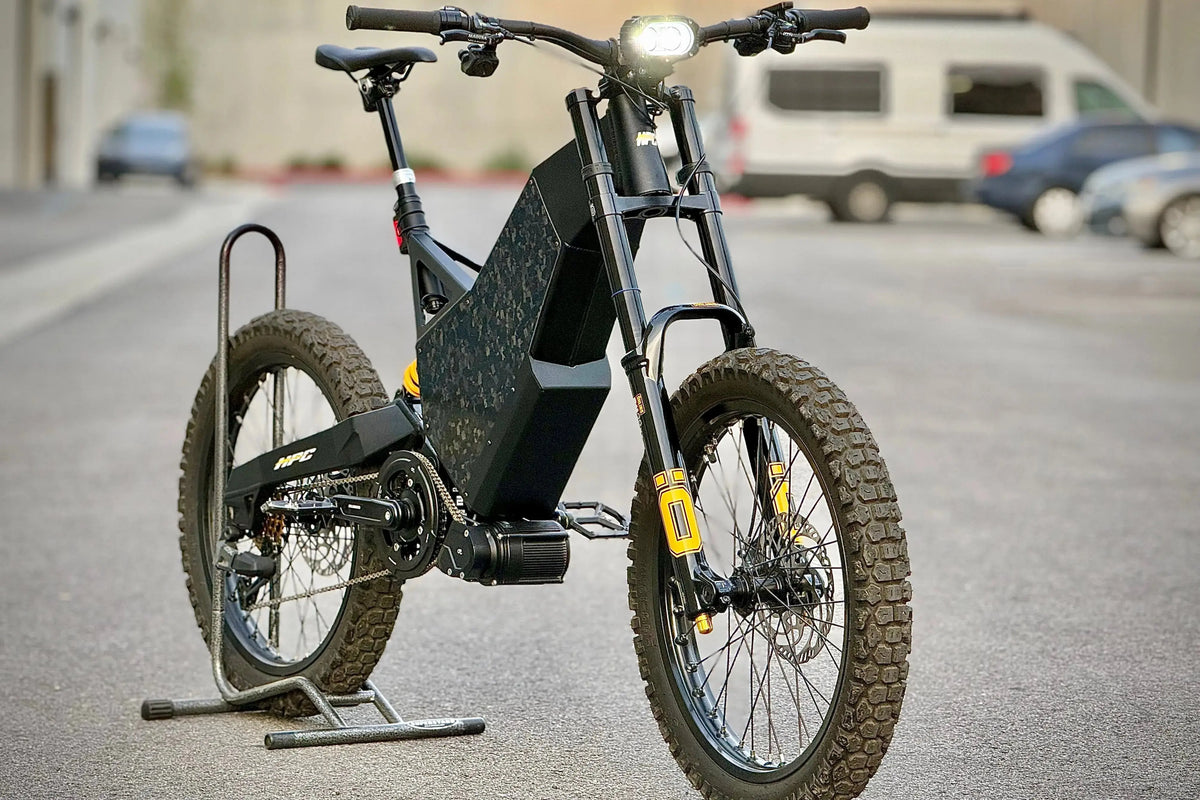
Maximum performance, off-road. This is where the Revolution X lives — 6,000W standard, 7,000W optional, dual-crown suspension, quad-piston brakes. Understand the legal position before you buy.
Rugged and simple. The Scout is a USA-built hardtail for people who want capability without full-suspension complexity.
Questions worth asking before you buy
- What are the watt-hours, not just the voltage?
- What class is it, and where does that let me ride?
- What brakes does it have, and are they sized for the weight and speed?
- Can I buy a replacement battery in three years?
- Who services it if something fails?
An honest seller will answer all five without hedging.
If you want a straight recommendation, tell us where you ride and how far, and we will point you at the right bike — including telling you when a cheaper one is the correct answer.
Comments