
50 MPH Electric Bikes: Which Models Really Reach 50
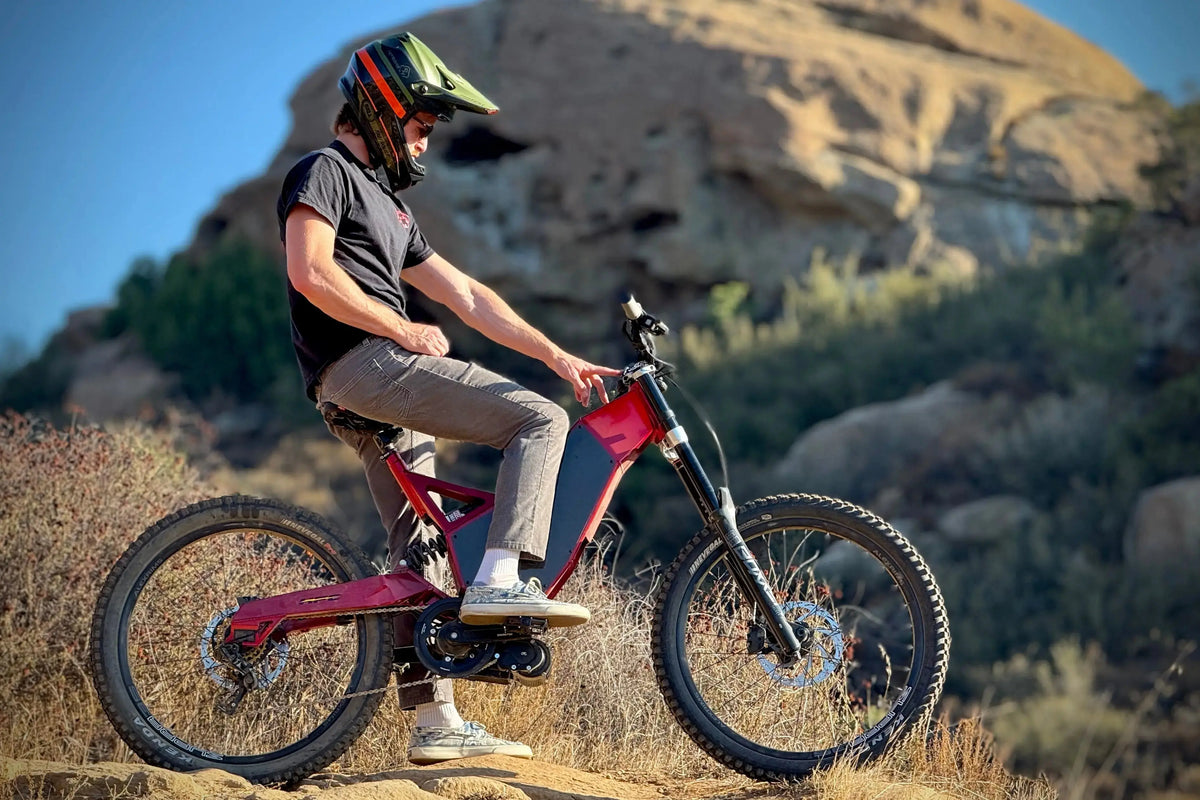
50 mph is the number where e-bikes stop being bicycles with a boost
Forty miles an hour is quick, and sixty puts you on a different kind of machine. Fifty sits right on the line. It's fast enough that the bike has to be engineered as a high-power platform from the frame up, but still a speed a rider can use on real terrain without a closed course.
It's also one of the most misunderstood numbers in the industry. Plenty of bikes advertise 50 mph, and it often turns out to mean a downhill run, a tailwind, or a hub motor spinning unloaded on a stand. Here's what actually has to be true for a bike to reach and hold 50, which Hi Power Cycles models get there, and what the law, especially in California, says about riding one.
What it actually takes to hold 50 mph
Aerodynamic drag rises with the square of speed, and the power needed to overcome it rises with the cube. That one fact drives everything else. Going from 30 mph to 50 mph isn't a 67% increase in effort. The power required roughly quadruples.
Three things have to line up:
- Pack voltage. Motor speed scales with voltage. A 48V system has a ceiling that no amount of current will push past. Getting to 50 mph in a usable way generally takes 72V or more.
- Sustained current, not just peak. A controller that spikes to a big number for three seconds isn't the same as one that delivers steady power while the bike fights drag at speed. This is where cheap controllers fail: they hit thermal limits and cut power exactly when you need it.
- The rest of the bike. You need brakes sized for the speed, a frame that stays composed, tires rated for it, and suspension that keeps the wheels tracking. The motor and battery get the attention, but at 50 mph the chassis is what keeps you safe.
The Revolution MX and MX Pro: 50 mph as a published spec
The Revolution MX is the model built around this number. It's a 72V downhill e-MTB, hand-built in the USA, rated for up to 6,000W, a 100-mile range and a 50 mph top speed. At $10,500 it's the most direct answer to "which e-bike actually does 50."
The 72V pack is the key. This isn't a 48V bike pushed hard. It's a platform designed at a voltage where 50 mph sits inside the motor's normal operating range, not at the ragged edge of it. The result is a bike that reaches 50 and stays composed, instead of touching it briefly and backing off.
The Revolution MX Pro also hits 50 mph. It runs the same platform on a 78V system at $12,500. We compare the two in Revolution MX vs Revolution MX Pro.
The Revolution lineup: 50 mph and beyond
The Revolution is HPC's long-running full-suspension downhill platform, and it reaches 50 too. With the Thunderbolt motor it's rated at 50-55 mph, with 5,000W, 6,000W or 10,000W power systems and battery options up to 100+ miles. Price starts at $11,000.
Above it, the Revolution lineup keeps going. The Revolution X is rated at 60+ mph on its 7,000W option, and the limited-edition Revolution W reaches 80 mph. If 50 is your floor rather than your ceiling, see The HPC Revolution Lineup Explained.
Where the Trailblazer fits
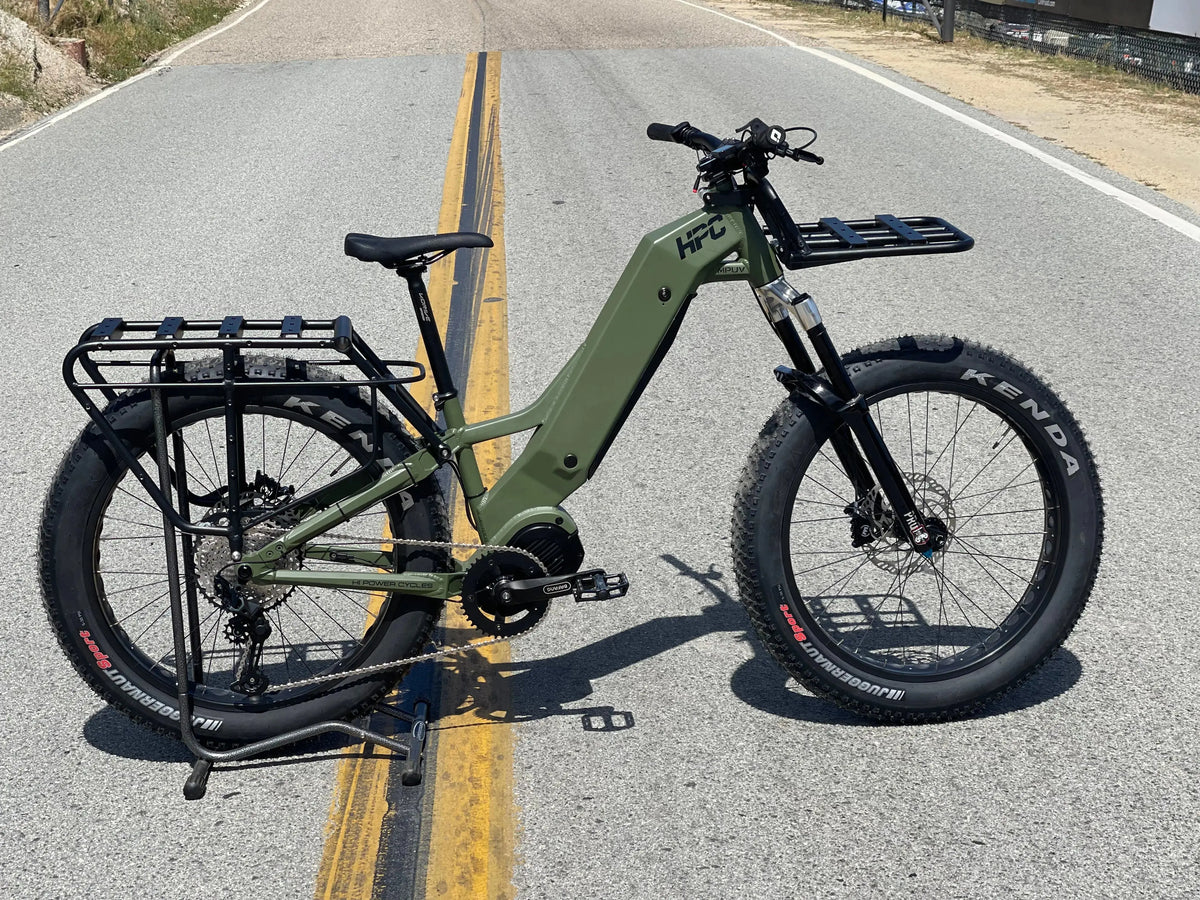
To be clear, the Trailblazer lineup isn't a 50 mph family. It tops out at around 40 mph, with the 2,000W Trailblazer Pro build rated at 38-40 mph. The Trailblazer is a full-carbon, full-suspension trail and enduro bike starting at $6,800, and it's superb at what it's built for: technical terrain, climbing and long trail days on a light chassis.
We include it here because many people searching for a "50 mph electric bike" don't really want one. They want something that feels fast and capable on trails, and the speed figure stands in for that. If that's you, the Trailblazer is very likely the better bike, and you'll spend less. See 40 MPH Electric Bikes for that end of the range.
Is a 50 mph e-bike right for you?
Most people shopping at this speed are adult riders stepping up from a regular e-bike or mountain bike. Before you buy, be honest about a few things:
- Riding experience. A 50 mph bike accelerates and brakes like a light motorcycle. Riders who already have downhill, dirt bike or moto experience adapt fastest. If you don't, build up speed gradually and get some coaching.
- Protective gear. A bicycle helmet isn't enough at 50 mph. Plan on a full-face, DOT-rated helmet, gloves, eye protection and body armor or a moto jacket.
- Brakes and tires. At this speed you need powerful hydraulic brakes and tires rated for the load. On the top Revolution builds that means Magura MT7 brakes on the X and Magura Gustav brakes on the W. Keep them maintained. Our Magura brake setup guide covers pads and fitment.
- Where you'll ride. You need private land, off-road areas or a registered-vehicle setup (more on that below). If most of your riding is on shared trails, a 50 mph machine is the wrong tool.
California law and legality
California has some of the most detailed e-bike rules in the country, and they changed again this year. Here's how they apply to a 50 mph bike. This is general information, not legal advice. Check the current California Vehicle Code and the DMV before you ride.
What counts as a legal e-bike in California
Under California law, an electric bicycle needs fully operable pedals and a motor of no more than 750W. It must also fall into one of three classes:
- Class 1: pedal assist only, assistance stops at 20 mph.
- Class 2: throttle allowed, but the motor stops assisting at 20 mph.
- Class 3: pedal assist up to 28 mph, with a speedometer. Riders must be at least 16, all riders must wear a helmet, and sales to anyone under 16 are prohibited as of January 1, 2026.
A bike that reaches 50 mph or makes several thousand watts doesn't fit any of these classes. Legally it isn't an e-bike in California, no matter what it looks like.
Laws already in effect
- SB 1271 (effective January 1, 2025) tightened the class definitions. Throttles on Class 1 and 3 bikes are limited to a low-speed walk-assist function, Class 2 throttles must cut out at 20 mph, and the law added battery and electrical safety-certification requirements.
- AB 1774 (effective January 1, 2025) makes it illegal to sell devices or software designed to modify an e-bike's speed so it no longer meets its class.
New for 2027: SB 1167
Governor Newsom signed SB 1167 on September 30, 2026, and it takes effect on January 1, 2027. It draws a firmer line between e-bikes and higher-powered electric vehicles:
- Devices that exceed the e-bike definition can't be marketed or sold as e-bikes.
- Sellers must disclose, including in online ads, that these devices are motor vehicles that need registration, operator licensing and insurance if used on public roads.
- The law expands the electric moped category (motors under 3,000W, up to 30 mph) and the motor-driven cycle category (electric motors up to 3,750W). On public roads both require registration, a license plate and an M1 or M2 motorcycle license.
- It also strengthens labeling, battery safety and crash-data requirements.
A 50 mph Revolution with a 5,000-6,000W system is above even the expanded motor-driven cycle threshold. In practice, in California these bikes are for private land and designated off-road riding, unless the specific vehicle can be registered under motor vehicle rules, which most can't.
Outside California
Most states follow a similar three-class system, so a 50 mph bike generally means off-road use, private land or registration as a motor vehicle. Rules vary by state and local land managers, so check before you ride. Our guide to street-legal fast e-bikes covers the class system in more depth.
This isn't a footnote to skip. Riding a 50 mph machine on a bike path is illegal and dangerous to everyone else on it.
Choosing
If you want 50 mph on the spec sheet and the engineering to back it, the Revolution MX is the straightforward pick, and the MX Pro adds more pack voltage on the same platform. If you want the long-running downhill platform with configurable power, choose the Revolution. If 50 isn't enough, the Revolution X and W go further. If what you really want is a fast, capable trail bike, the Trailblazer family (up to about 40 mph) will make you happier than any of them.
The number on the spec sheet matters far less than whether the bike suits the riding you actually do, and where you're allowed to do it.
Comments