
E-Bike Battery Chargers: Voltage, Amps & Charge Time
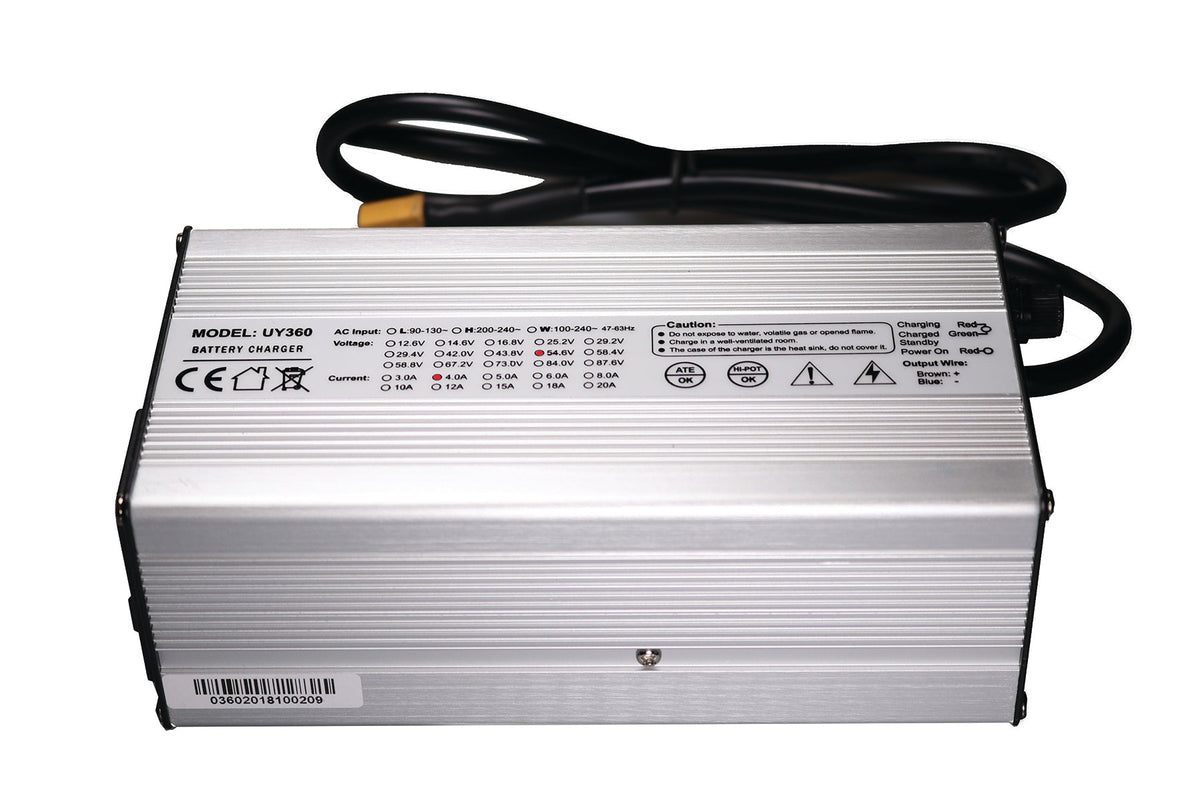
Choosing an e-bike battery charger comes down to three questions: what voltage is your pack, how fast do you want to charge it, and does the plug match? Get the first one wrong and the charger either will not work or will not fill the pack. This guide covers how to match a charger to your battery, what 4A and 6A really mean for charge time, and how to charge in a way that is easy on the pack.
Step 1: match charger output voltage to pack voltage
A lithium pack is described by its nominal voltage and its number of cells in series (the "S" number). A charger must output the full-charge voltage for that cell count. That is why a "48V" pack needs a charger that outputs 54.6V, not 48V. Our smart chargers are named by pack, with the actual output voltage in the title:
| Pack voltage | Cells | Charger output | Price (as listed) |
|---|---|---|---|
| 36V | 10S | 42V | $100 |
| 48V | 13S | 54.6V | $140 (4A), $200 (6A) |
| 52V | 14S | 58.8V | $120 |
| 63V | 17S | 71.4V | $180 (4A), $270 (6A) |
| 74V | 20S | 84.0V | $220 |
| 84V | 23S | 96.6V | $250 (4A), $350 (6A) |
All six are Intelligent Lithium Smart Chargers that work on 110V or 220V mains and ship with an XT60 connector installed, per their product pages. Stock changes, so check each page for current availability. For the background on higher-voltage systems, see High-Voltage E-Bike Battery Systems: 48V to 86V Explained.
Searching for a specific size? The 84V 23S charger (96.6V output) is the one for 84V and 86V packs, and the 74V 20S charger (84.0V output) covers 74V packs. Our 52V charger outputs 58.8V.
Step 2: choose a charge speed (2A, 4A, 6A)
Charge time is roughly the pack's amp-hours divided by the charger's amps. The product pages give these real figures for a typical 12Ah battery:
| Charger current | Approx. time, typical 12Ah battery |
|---|---|
| 2A | About 6 hours (52V charger) |
| 4A | About 3 hours |
| 6A | About 2 hours |
| 8A | About 1.5 hours (52V charger) |
The 84V charger variants are listed at a roughly 4 hour charge for 4A and a 2.5 hour charge for 6A on its variant names, so check the page for your exact pack size. Larger packs take proportionally longer.
The 4A to 6A sweet spot
A general rule of thumb is to keep charging at 1C or less. "C" is the pack's capacity in amp-hours, so 1C on a 12Ah pack is 12A. Staying at or under that keeps stress and heat on the cells low. Beyond that limit, faster charging mostly trades pack life for minutes saved.
At HPC we believe the sweet spot for most e-bike batteries is 4A to 6A, which is a good blend of charge speed and gentle treatment. It fills a typical pack in a few hours, which suits an overnight charge or a lunch-break top-up, without pushing hard on the cells. This is why the 48V, 63V and 84V chargers are offered in 4A and 6A versions. If your pack is small, check that its capacity makes your chosen current land at or under 1C, and ask us if you are unsure.
Step 3: check the connector
The charger needs to plug into your battery without adapters you do not trust. Our smart chargers come with an XT60 connector installed. If your pack uses XT90 or Anderson connectors, read E-Bike Charging Connectors Explained before changing anything. Never splice or force a mismatched plug. If in doubt, ask the team.
When to choose the Cycle Satiator
A fixed-voltage charger does one job. The Cycle Satiator is a variable-voltage programmable smart charger for packs from 36V (10S) up to 86V (23S). Its listing says the price ($500) includes up to five set profiles plus wiring of your matching connector, and describes custom profiles to extend range and pack life. It has an OLED display showing real-time charging data, a sealed watertight enclosure, and no fan. Read the full breakdown in Cycle Satiator Smart Charger: Programmable Charging for High-Voltage E-Bike Batteries. It is a good fit if you own several packs at different voltages or want a custom charge profile. Check the product page for current availability, as lead times may apply.
Charging habits that help your pack
- Use the right charger. Matching output voltage to cell count is the most important rule.
- Stay at or below 1C when you can, and favor 4A to 6A for everyday charging.
- Charge where it is cool and dry, on a hard surface, and do not leave a charging pack unattended in hot conditions.
- Unplug when full. Smart chargers stop when the pack is full, but there is no reason to leave a pack on the charger for days.
- Inspect cables and connectors for heat damage or loose pins before each charge.
For more on long-term care, read How to Maintain Your E-Bike Battery. If you charge off-grid, the HPC 400W MPPT solar charge controller supports 48V through 86V packs.


Comments